
Originally published as Chapter Six of Through These Doors.
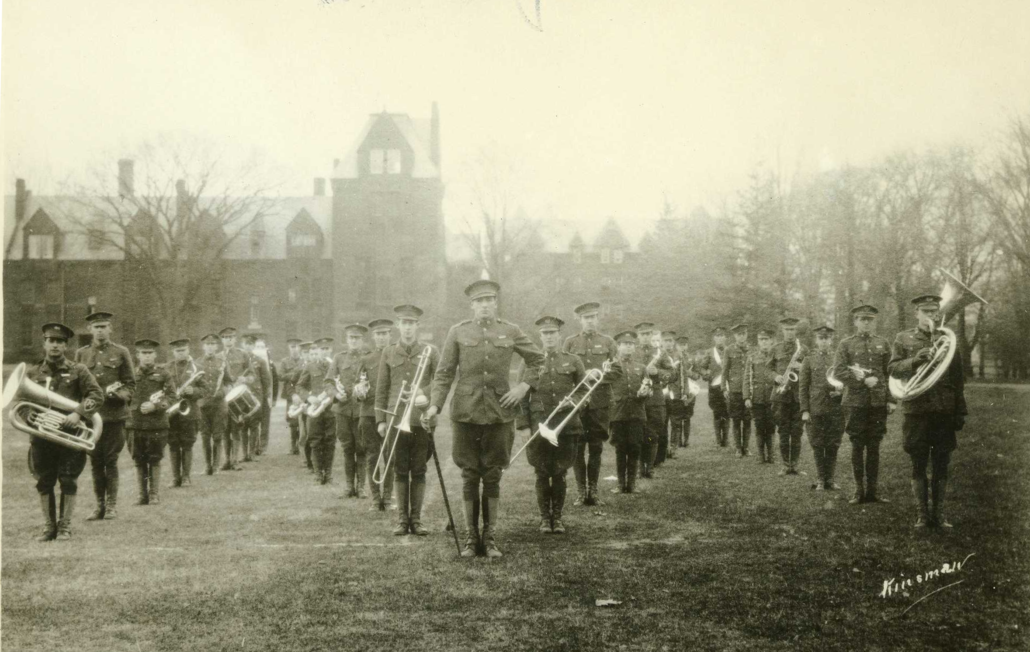
By April 1920, Mass Aggie’s Alumni Association, which had become an established and recognized group, felt it was time to create new traditions. It proposed to hold a parade at the end of each school year, where all alumni classes would dress up and march to the final college baseball game. Since a band was needed for such a parade and because the Aggie army no longer had a band, something had to be done. The alumni took matters into their own hands and set out to recruit a band. Students agreed with the alumni and felt that a volunteer group like the band was also an important part of athletic games. The band had been entertaining at halftimes, and the “zip and whim” it inspired caused the fans to cheer louder for the team. The band was greatly responsible for pushing teams to victory. Extensive recruiting efforts paid off, and for the June 19, 1920, Vermont baseball game, a newly formed Aggie fife and drum corps led the Alumni Parade from North College to the baseball game at Alumni Field. Following Commencement, the first stone was laid for Memorial Hall on June 20, to honor veterans of World War I.
By the fall of 1920, 833 students were enrolled at MAC, and the band was getting back into the swing of things under the leadership of Ray Swift. By October, twenty-two men reported for the first band rehearsal in the Social Union Room in North College. To entice students to join the band and attend rehearsals, that year, for the first time, each band member received one college credit per term for participating in the group. Since the band was still under the jurisdiction of the military department, which prohibited women from being cadets, women were not allowed to join until later.
The revitalized band was known as “The Aggie Band,” and the group’s instrumentation consisted of five trumpets, four clarinets, three trombones, two saxophones, three alto horns, three drums, one baritone horn, and one bass horn. The military department provided instruments for those who did not have their own, and Swift rehearsed the band frequently in order to have a “top-notch group in shape” for the October 30 New Hampshire game. Students hoped that the band would regain “its previous stature as an important college organization.” Swift’s efforts were successful, and at the game, the band gave a solid showing and received praise for its successful reorganization. The football team continued to grow as well, and on October 2, picked up its hundredth win in school history, defeating Connecticut 28–0.
On November 13, after six hundred students took the train to Springfield, the band led the student body to the MAC-Springfield football game. Although the Aggies lost 28–7, they paraded back to the train in good cheer, blocking traffic and singing happily. Students felt that the college spirit was improving and that a great deal more “pep” was seen than in previous years.
The military department underwent additional changes, and in the fall, the infantry ROTC became a horse cavalry unit. Cavalry tactics replaced infantry basics for juniors and seniors, although freshmen and sophomores were still required to take infantry. Although students were sometimes less than fond of infantry drill, they greatly enjoyed riding horses during cavalry drill.
For the Amherst baseball game on June 11, 1921, the Aggie Band led the Alumni Parade, which was made memorable by the “band, costumes, and pep.” After the game, the band gave a concert as part of the college’s Semi-Centennial Commencement. A lawn festival was part of the celebration, as tents were pitched by Chapel and electric lights and Japanese lanterns were hung along the roadside. In addition, for the first time in many years, the band played at the Commencement exercises.
By the fall of 1921, there was interest in having a large and well-organized college band. Recruiting ads ran in various issues of the school’s newspaper, urging all men who could play an instrument to come to the 4:30 p.m. Friday rehearsals in the North College Social Union Room. The band wanted to play at the Tufts game, but until more men joined, the group’s activities were limited.
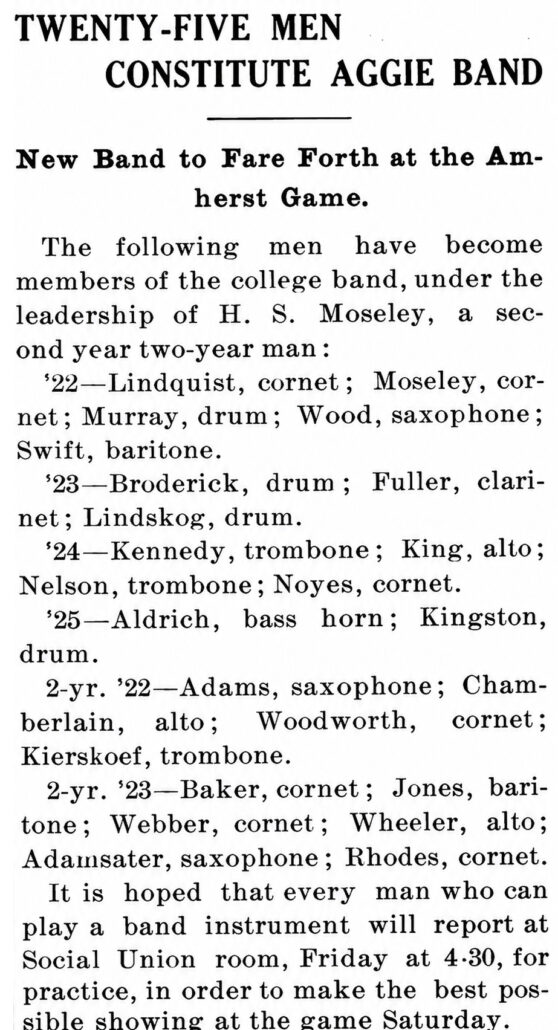
Apparently the recruiting drive worked. In December, after a successful marching season, band members created a basketball band to play for home games, one of the earliest incarnations of the modern-day Minuteman Hoop Band. At this time, entertainment at basketball halftimes consisted of students singing Aggie songs, and all were encouraged to bring their songbooks and join in. Basketball games were played in the drill hall, and halftime allowed the students to learn the less-familiar college songs.
In April 1922, the ROTC freshman class formed a drum and bugle corps under the leadership of drum major John Nylen ’25. The group, which consisted of six buglers, three snare drummers, and one bass drummer, rehearsed three mornings a week and was recognized for its rapid progress. This year marked one of the few during which the college band did not play for the spring military review or other military events.
President Butterfield was an active supporter of the band and asked Cavalry Maj. Frederick E. Shnyder if the U.S. Army would issue sets of band instruments to the college. He also wondered if it was possible for band members to rehearse during the hours reserved for military instruction. In October 1922, Shnyder sent a memo to Butterfield stating that sets of band instruments could only be issued to senior units of four hundred or more, but that it was possible to permit band rehearsal during the military period. Although the band did not receive new instruments, it was allowed to rehearse during military time and, as in previous years, band members were exempt from drill.
The college band held a rehearsal in North College on October 25, and although all band members were encouraged to be present, only twelve students attended. After more recruiting through Massachusetts Collegian articles and the warning that if more men did not come to rehearsal, it would be impossible for the band to play at the Tufts game, seventeen men attended the next meeting. The band leaders admitted that seventeen students represented a better showing than before. However, it was still not as good as could be expected; there were at least thirty-five men in college who played instruments, and every one of them should be in the band.
In spite of some recruiting issues, the November 15, 1922, Massachusetts Collegian reported that a highly successful Tag Day was organized to raise money for the college band to go to the Tufts game. Twenty students sold seven hundred red ribbons to students and faculty members, which brought in one hundred dollars and allowed the band to travel to the November 18 game. 163 students, including the football team and the band, took a specially chartered train to Tufts. Bostonians in North Station were amazed when the MAC Special pulled in, and they wondered if the fine band they saw was the West Point Band or that of the Salvation Army. At the football game, Tufts won for the first time in four years by a score of 9–6, although the Aggies backed their team to the limit. On the train trip back, the band split into various groups and kept things lively, playing music for the rest of the students in each of the cars.
The band resumed playing for the military department in the spring of 1923. When 250 members of the state legislature visited for Massachusetts Agricultural College’s May 4 military review, the corps of cadets put on an exhibition of drilling and horsemanship. The visitors were most impressed by the school’s spirit, and the college band played a large role in the day’s success with its “splendid work” during the review. The troops were aligned and disciplined, the spectators applauded long and hard, and the school made a good impression. One of the assembly speakers went so far as to say that MAC was “the finest agricultural college in the world.”
The review came at a good time, since the state legislature was debating whether a public state college was needed in the Commonwealth of Massachusetts. State Senate President Frank G. Allen said that, if such an institution was needed, “Where could we find a greater beginning than here” in Amherst? In addition, Speaker of the House R. Loring Young prophesied a brilliant future for Massachusetts Agricultural College. The positive sentiment and successful military reviews went a long way to ensuring that when the time came for Massachusetts to have a public state school, it would be placed in Amherst at the site of President Clark’s agricultural college.
In the fall of 1923, the band kept up its military commitments, although not much mention was made of its other activities. The college orchestra was revitalized under the guidance of William Davis, professor of botany, a former band leader at the University of Illinois. The college band was mentioned again on January 10, 1924, when Cadet Sgt. Emery Loud was detached from Troop A and became the band’s new drum major. In the spring, Davis, a professional clarinetist who also performed with the Northampton American Legion Band, assumed the role of unofficial band director. The band performed at the May ROTC inspection, and the band members were commended on their fine appearance.
In the fall of 1924, the band was under the command of Sgt. Everett Pyle ’27. Students continued to give financial support to the band, and for many years, the group existed and traveled mainly because of the generosity of fellow students. In November, a collection was taken up after Chapel Assembly in order to send the college band to the November 22 Tufts game. The students raised enough to meet more than half the expenses, and the band was able to make the trip. However, more stable funding for the college band was still many years away.
Although finances were volatile, the band continued to make steady progress. Pleased alumni wrote that there was a “real band” at the November 1 MAC-Amherst game, the best that had been seen in some time. The band paraded well, sounded good, and provided an “inspiring spectacle” at the game. Observers felt the band was getting better and better each year, with improvements in music, songs, and cheers. The band ended its season on June 13, 1925, and gave a concert for Alumni Day before leading the Alumni Parade to the MAC-Connecticut Agricultural College baseball game.
In the fall of 1925, the Aggie Band traveled to the October 17 Massachusetts-Connecticut football game in Storrs, where MAC won 13–0. After hearing Connecticut’s band, the Massachusetts students voiced their appreciation of the MAC Band. Apparently, the Conn Aggie Band had been organized the day before the game, and band members had differences of opinion regarding what key the music was in. For the November 4 MAC-Amherst game, after the Aggies lost 27–0, the Massachusetts Collegian ran a story with the humorous headline, “Chief feature of the game? Our Band.” During this time, the athletic teams at Mass Aggie often carried the nickname “Agates,” chiefly for variety and because students felt being called “Aggies” was becoming tiresome.
By the middle of November, the MAC Band was acknowledged as one of the stars on campus. As an incentive for students to attend the rally for the November 21 Tufts game, the Massachusetts Collegian advertised in big block letters, “The Band Will Be There.” In addition, the band led the rally parade from fraternity row to Stockbridge Hall, after which seven hundred students attended the energetic rally.
The Student Senate was supportive of the college band, and since a majority of the college community wanted to have the group present at the Tufts game, the Senate collected the needed funds. At the game, the Agates won the day 6–4, and the band provided spirited entertainment.
In 1926, the band played for the ROTC commissioning exercises, and photos show band members in the military’s olive-drab uniforms. The band wore the military dress only during specific military events, such as drills, reviews, and ceremonies. During football season, students made do with matching civilian attire, such as maroon sweaters, white shirts, and black pants.
The Massachusetts Agricultural College held its first Homecoming in the fall of 1926. On October 30, over three hundred alumni returned to campus and enjoyed lunch before cheering at the Massachusetts-Amherst College game. Although the Agates fought bravely, they were defeated 21–7 by the heavier and more experienced Amherst team. The alumni concluded the day with an evening dance.
In November, a Tag Day was organized to help send the college band to Tufts with the general student cheering section, and tags were on sale for fifteen cents each. Without such active campus support, the band would not have been able to support the football program successfully.
Capt. Edwin Miles Sumner, a strong advocate, friend, and future director of the MAC Band, joined the military department in October 1926. Before long, his efforts would take the college band to new heights, and the next few years marked one of the most prolific periods of growth in the band’s history.